
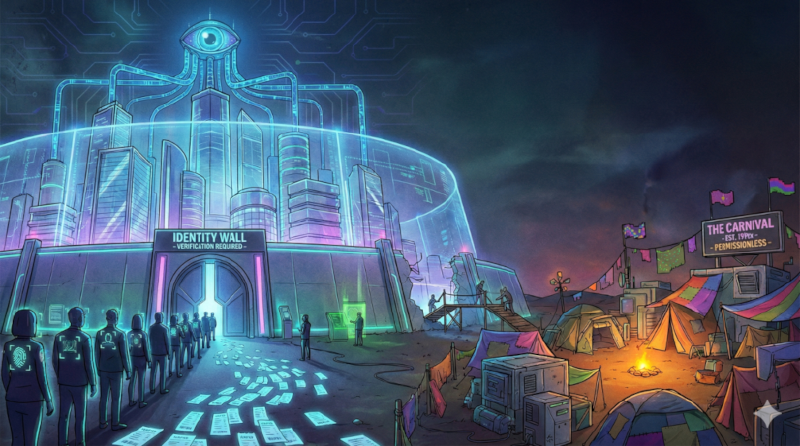
The Great Digital Enclosure: Why the Carnival is Closing#
For anyone who remembers the internet of the 1990s, it felt like a perpetual carnival. It was a chaotic, resilient “internetwork” of independent Bulletin Board Systems (BBS), Usenet groups, and IRC chatrooms. You didn’t “log in” to the internet back then; you entered a decentralized frontier where curiosity, not an algorithm, determined your next destination.
The architects of this world—visionaries like Vinton Cerf and Bob Kahn—built foundational protocols like TCP/IP to prioritize interoperability over commercial extraction. Their goal was a network that could survive a targeted attack by avoiding any central point of control. But somewhere between the first four nodes of ARPANET in 1969 and the mass-market explosion of 2026, the dream of “democratized data access” began to shift.
The “Convenience” Trap#
Today, the internet is no longer a distributed web; it is a series of high-walled corporate enclosures. We traded the friction of independent forums for the seamless convenience of a unified digital identity. We preferred having one account to access thousands of subreddits or Discord servers rather than managing dozens of separate credentials.
But that convenience has led to a “platform capture” from which there is no easy exit:
- Economic Determinism: Natural monopolies like Google and Meta now control the vast majority of infrastructure and traffic.
- The Death of Innovation: We have traded “permissionless innovation” for “walled gardens” where every move is dictated by a central authority.
- The Identity Wall: In 2026, your “throwaway” account is a relic of the past as mandatory ID laws turn these platforms into digital checkpoints.
We are currently living through a “pay for it” moment. While centralization brought us the “always-on” experience we craved, it also built the most efficient surveillance dragnet in human history. This isn’t just about losing our favorite niche forums; it’s about a structural reckoning where the line between participating in a community and submitting to state surveillance has functionally vanished.
The Gravity of Giants: Why the Web Collapsed Into Itself#
If the early internet was a wide-open frontier, the modern web is a series of massive, high-gravity planets. You don’t just “visit” them; you get sucked into their orbit.
It wasn’t an accident, and it wasn’t just because these companies had better logos. It was a matter of cold, hard physics—or rather, the digital version of it. Understanding why we ended up in these walled gardens requires looking at the invisible forces that made centralization feel like the only logical choice.
The “Everyone Is Here” Trap#
In the early days, if you didn’t like how a forum was being run, you could just start your own. It was the digital equivalent of moving to a new park. But today, the internet has developed its own version of gravity.
There’s a concept called Metcalfe’s Law. It sounds technical, but it’s actually the most human rule on the internet: a network’s value depends entirely on how many people are already using it. A phone is useless if you’re the only person who owns one. A social media app is a graveyard if your friends aren’t there.
We didn’t necessarily choose the biggest platforms because they were the “best”—we chose them because that’s where the people are. This creates a “virtuous cycle” for the giants: the bigger they get, the harder it becomes for anyone to leave. Eventually, “opting out” of a platform starts to feel like opting out of your social life or your career.
The “Polished” Barrier#
You don’t need a billion dollars to build a new app, but you do need a billion dollars to make it feel as “seamless” as the ones we’re used to.
We’ve become addicted to the “one-click” life. We expect to log in with a single button, have our photos sync instantly, and see a perfectly curated feed. For a small, independent developer, matching that level of polish is an exhausting uphill battle.
Because the giants own the “identity” (your Google or Facebook login) and the “pipes” (the servers and app stores), they’ve set the bar for entry. If a new community feels even slightly “clunky” compared to Discord or Reddit, most people won’t give it a second look. We’ve traded the wild, creative messiness of the old web for a polished, corporate experience—and that polish is exactly what keeps us trapped inside the walls.
The Intermediary Tax#
Today, the giants sit in the middle of everything. They are the gatekeepers between the writer and the reader, or the creator and the fan.
In this environment, “innovation” has changed. It’s no longer about building something truly independent; it’s about building something that fits inside the existing ecosystem. We didn’t lose the open web because we were lazy; we lost it because the convenience of staying put became easier than the friction of moving. But as we’re finding out in 2026, that convenience came with a hidden price tag.
The Identity Wall: The End of the “Throwaway” Account#
If the early internet was a masquerade ball where you could be anyone, 2026 is the year the lights came up and everyone was told to show their papers. We are hitting an “Identity Wall”—a shift from the “permissionless” web to a world where a verified legal identity is the cover charge for basic digital participation.
The “Seatbelt Moment” for the Web#
For decades, being anonymous online was the default. You could join a forum, share a radical opinion, or ask a sensitive health question without it ever being tied to your real name. That era is officially ending, catalyzed by a wave of global legislation that treats digital anonymity as a safety risk.
The turning point was July 2025, when the UK’s Online Safety Act went into full effect. It mandated “highly effective” age verification for platforms hosting adult content, but the ripples moved fast. Because “adult content” is broadly defined, major social platforms began implementing identity checkpoints to avoid massive fines—up to 10% of their global turnover. Similar laws like the Digital Services Act in the EU and proposed acts in the US are turning these corporate “walled gardens” into mandatory identity checkpoints.
Proving You Exist: Biometrics and Open Banking#
Gone are the days of just clicking a box that says “I am over 18.” To pass the Identity Wall in 2026, platforms are requiring “robust and reliable” methods:
- Facial Age Estimation: Using AI to analyze a live selfie to estimate your age.
- Photo ID Matching: Uploading your passport or driver’s license and matching it to a biometric face scan.
- Open Banking: Securely linking your bank account to verify your legal status.
On the surface, this is framed as child protection. But in practice, it means every subreddit you visit, every Discord server you join, and every political thread you comment on is now potentially linked to your government-issued ID.
The Chilling Effect#
This isn’t just a technical hurdle; it’s a social one. The “Identity Wall” has created an immediate chilling effect for those who rely on privacy the most.
- Journalists and Researchers: Finding it harder to access sensitive information without leaving a permanent digital trail.
- Marginalized Communities: Groups like the LGBTQ+ community, who often find safety in anonymous digital spaces, are being forced to tie their online lives to their legal identities.
By 2026, the “throwaway” account has become a relic of a more innocent age. We are now building a permanent “paper trail” for human thought—and as we’ll see in the next section, that trail leads directly to the front door of government surveillance.
The Surveillance Pipeline: From Subreddits to DHS Databases#
The transition from a decentralized web to a centralized one has fundamentally altered the relationship between users and the state. While independent forums of the past were governed by local norms and independent moderators, today’s digital life is funneled through a few massive databases. This structural shift has created a high-friction “dragnet” for government agencies, turning what were once private community interactions into searchable records for federal oversight.
The Power of the Administrative Subpoena#
A primary tool in this new era of surveillance is the administrative subpoena. Unlike search warrants, these requests do not require the approval of a judge. They allow agencies to demand identifying information—including real names, email addresses, phone numbers, and IP logs—from platforms with very little friction.
By early 2026, the scale of this pipeline became clear when it was revealed that the U.S. Department of Homeland Security (DHS) had issued hundreds of these subpoenas to major tech hubs, including:
- Meta
- Discord
These requests specifically targeted accounts that voiced political opposition or tracked the movements of Immigration and Customs Enforcement (ICE). Reports indicate that Google, Meta, and Reddit have “willingly complied” with many of these requests, providing the identifying information of critics directly to the DHS.
The Panopticon Architect: Thiel and Palantir#
The danger of this centralization is compounded by the specific vendors chosen to manage our digital identities. As platforms like Discord and Reddit roll out mandatory age verification, they have partnered with a vendor called Persona.
Persona is backed by the Founders Fund, a venture capital firm co-founded by Peter Thiel, who also co-founded Palantir Technologies—the primary data-mining contractor for ICE. This creates a direct and alarming link:
- The Verification Side: Users scan their IDs through Persona to access a Discord server or subreddit.
- The Enforcement Side: Palantir has developed “ImmigrationOS,” an AI-driven system designed to track and deport noncitizens by integrating social media profiles, passport records, and tax files.
The connection between these two entities through Thiel’s network creates a functional “digital panopticon”. When you scan your ID to participate in an online community, you are potentially feeding data into an ecosystem controlled by the same individuals who build the software used to target political critics and immigrants.
The “Paper Trail” of Human Thought#
In this centralized environment, the era of the anonymous “throwaway” account is effectively over. Every political opinion expressed or community joined now leaves a permanent, traceable paper trail. For individual users, fighting these data requests is nearly impossible; platforms often give users only 10 to 14 days to contest a subpoena in court, a timeline that is functionally useless for most people.
The result is a “pay for it” moment for the public: in exchange for the convenience of centralized platforms, we have unknowingly built a searchable database of political dissent for the state.
The Organic Traffic Crisis: The Death of the Open Web#
The centralization of the internet isn’t just social or legal—it is informational. For decades, the “Open Web” survived because of a simple, unspoken agreement: independent creators provided the content, and search engines provided the audience. In 2025, that agreement was effectively torn up during what analysts call the “Great Decoupling”.
The “Zero-Click” Trap#
Historically, if you searched for a complex topic, you clicked a link to a niche blog or an independent news site to find the answer. Today, you likely don’t even have to leave the search page.
Recent data reveals a staggering shift in how we consume information:
- The 60% Rule: Roughly 60% of all Google searches now end without a single click to an external website. On mobile devices, that number jumps to nearly 77%.
- AI Scraping: Google’s “AI Overviews” use content scraped directly from independent publishers to answer your questions on-site.
- The Result: The very publishers providing the data for these AI models are being starved of the traffic they need to survive.
The Starvation of Niche Content#
This isn’t just a problem for big media companies; it is an existential threat to the independent voices that made the web interesting. When search engines prioritize their own AI-generated answers and ads, traffic to independent sites plummets.
- Major Declines: Some established platforms saw their organic traffic drop by 70–80% between 2024 and 2025.
- Diversity Loss: Niche content is disappearing as smaller blogs find it impossible to monetize their work without a steady stream of visitors.
The Sole Arbiter of Truth#
This creates a dangerous feedback loop. As independent sites die off, the centralized search engines and social hubs become the sole gatekeepers of information. When there is nowhere else for users to go, these platforms become even more susceptible to government “requests” for information filtering or de-masking.
The “Open Web” is being replaced by an informational walled garden where the search engine is no longer a map to the world—it is the world.
The Resistance: The Backyard DIY Carnival#
But here is the thing: while the walls are high, they aren’t airtight. And that is actually… kind of great? Because while the giants were busy building their gold-plated enclosures, a group of stubborn, brilliant “digital gardeners” was busy building an escape hatch.
It’s called the Fediverse, and it’s the closest thing we have to the original, chaotic spirit of the 1990s.
The Fediverse: No Landlords Allowed#
Imagine a version of social media where nobody “owns” the building. Instead of one giant Reddit or one monolithic Twitter, you have thousands of smaller, independent “instances” (like Mastodon or Lemmy) that all talk to each other through a protocol called ActivityPub.
It’s the “backyard DIY” version of the web. If you don’t like the rules of one community, you don’t have to quit the internet; you just move to a different server. You keep your friends, you keep your posts, and you leave the “landlord” behind.
The “Threads” Dilemma (A Backhanded Compliment)#
Even the giants are starting to realize that the walls are a problem. When Meta launched Threads and announced it would eventually integrate with the Fediverse, it wasn’t out of the goodness of Mark Zuckerberg’s heart. It was a white flag. It was an admission that the future of the web might actually be decentralized.
Sure, there’s a risk of “corporate capture,” but the fact that the world’s biggest social media company feels the need to play in our backyard proves that the “Open Web” isn’t a dead dream—it’s a growing threat to their bottom line.
Conclusion: Reclaiming the Frontier#
So, where does that leave us? Are we all doomed to be indexed, verified, and subpoenaed until our digital lives are just one long, transparent spreadsheet for the DHS?
Not necessarily. We are at a massive crossroads, but we still have our hands on the wheel. We can’t just “delete our accounts” and go live in the woods (mostly because the woods have terrible Wi-Fi), but we can change how we inhabit this space.
- Demand Zero-Knowledge: We need to push for “zero-knowledge” verification—systems that prove you’re a real person or a certain age without actually handing over your government ID to a corporate database. The tech exists; we just need to stop accepting the lazy alternative.
- Support the “Small” Web: Read an independent blog. Join a Mastodon instance. Post somewhere that doesn’t have a “Share Price.” Every time you step outside a walled garden, you’re helping to starve the giants of the one thing they need to survive: your attention.
- Remember the Carnival: The internet wasn’t built to be a shopping mall or a police station. It was built to be a tool for human connection.
The “Digital Enclosure” of 2026 is real, but it’s only permanent if we stop trying to climb the fence. The carnival isn’t actually closing; it’s just moving to a different, slightly messier, much more interesting neighborhood.
And honestly? The music is better over there anyway.