Introduction: The Irony of the Automated Guard#
The security of modern software is no longer just about the code we write; it’s about the “plumbing” we use to deliver it. We’ve entered an era of high-speed automation where Continuous Integration and Continuous Deployment (CI/CD) pipelines, like GitHub Actions, are the primary engines of software delivery. However, this shift has created a massive new target for attackers.
There is a deep irony in the recent breach of Trivy, a tool maintained by Aqua Security that is specifically designed to scan for vulnerabilities. In early 2026, the very tool used to protect thousands of organizations became the delivery vehicle for a sophisticated supply chain attack. This landmark case study reveals a harsh reality: the “secure by default” settings we expect from our automation platforms are often more of an aspiration than a reality. It was a digital heist where the convenience of automation was weaponized against the community it was built to serve.
Act I: The AI Bot and the “Pwn Request”#
The first cracks in the armor appeared on February 28, 2026. The antagonist of this opening act wasn’t a human typing at a terminal, but an autonomous AI-driven bot known as “hackerbot-claw”. This bot didn’t need to discover a groundbreaking “zero-day” exploit; it simply targeted a well-known architectural flaw in GitHub Actions: the pull_request_target trigger.
In the world of GitHub Actions, this trigger is a double-edged sword. While standard pull requests run in a restricted sandbox, pull_request_target runs with the full privileges and secrets of the home repository. By submitting a carefully crafted pull request, the bot tricked the system into giving it the “keys to the house”—specifically, a privileged Personal Access Token (PAT).
The initial damage was swift and disruptive:
- Total Takeover: The attacker gained full control of the repository and renamed it to
private-trivy. - Wiping History: They deleted years of work, specifically historical GitHub Releases ranging from version v0.27.0 to v0.69.1.
While Aqua Security’s team scrambled to regain control and rotate credentials by March 1, the attackers had already planned their next move. They successfully exfiltrated newly rotated secrets during a brief “rotation window” where the old and new credentials overlapped—setting the stage for an even more dangerous second phase.
Act II: The Magic Trick (Git Tag Re-pointing)#
On March 19, 2026, the situation escalated from a localized breach to a full-scale supply chain assault. A threat actor group known as “TeamPCP” used credentials they managed to exfiltrate during the initial February incident to launch a remarkably deceptive attack.
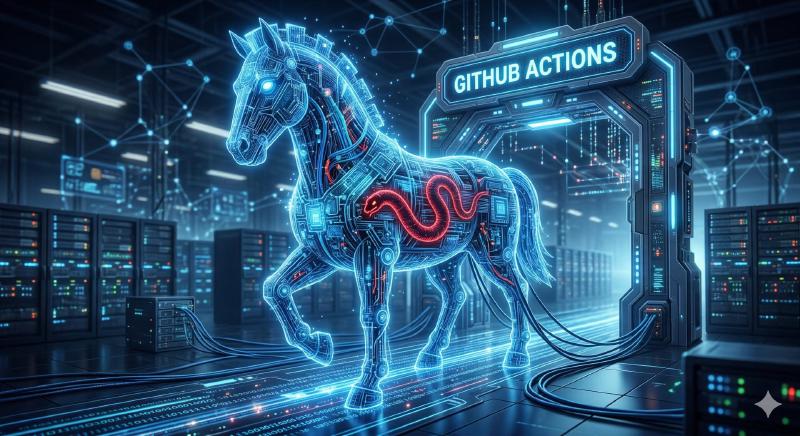
Instead of pushing a suspicious “new” version that might trigger alarms, they performed a digital sleight of hand known as “Git tag repointing”. We often treat version tags—like v0.34.2—as immutable stamps of approval, but in reality, they are just pointers that can be moved. The attackers force-pushed 76 out of 77 release tags in the trivy-action repository, redirecting them to malicious “dangling” commits.
The sophistication of this phase was in its invisibility:
- Spoofed Metadata: The attackers used
GIT_AUTHOR_DATEto fake historical timestamps and reused legitimate author names, making the changes invisible to anyone casually browsing the release page. - The “Memory Thief”: Hidden inside was a sophisticated infostealer. Unlike typical malware, it didn’t just look for files; it scraped the actual memory of the GitHub Actions runner to bypass native log-masking and harvest secrets marked as “secure” by the platform.
- Blockchain Stealth: It even used the Internet Computer (ICP) blockchain for its command-and-control center, making the coordination nearly impossible to shut down via traditional means.
The “Ripple Effect”: From One Breach to Thousands#
When a tool as trusted as Trivy is compromised, the damage doesn’t stay contained within one repository. Once TeamPCP gained access to NPM deployment tokens, they unleashed a self-propagating nightmare called the “CanisterWorm”.
This worm turned the software supply chain into a delivery network for infection:
- The Theft: It used stolen tokens to publish backdoored versions of common NPM packages.
- The Spread: When other developers pulled these packages into their automated pipelines, the worm activated, stole their credentials, and continued the cycle.
- The Target: It specifically targeted high-value scopes, such as @opengov, demonstrating that attackers are no longer just going after individual servers; they are targeting the entire ecosystem through the very tools we use to build it.
By the time the dust settled on March 23, the attackers had leveraged service account abuse to make 44 internal, private repositories public, exposing the internal guts of organizations that thought they were protected.
Why Did This Happen? (The Defaults Trap)#
If you’re wondering how a security-focused tool could fall so hard, the answer isn’t just “better hackers.” It’s “dangerous defaults.” For years, the industry has prioritized making automation “just work” right out of the box, often at the expense of security.
The Trivy incident highlighted three critical systemic failures:
- Insecure by Design: Many GitHub Actions settings are permissive by default to reduce friction for developers. This includes the
pull_request_targettrigger, which—if not handled with extreme care—creates a massive back door. - Permission Bloat: Every GitHub Action is assigned a
GITHUB_TOKEN. By default, these tokens often have broad “read/write” permissions. In this case, the attackers didn’t have to “break in” to get write access; the platform handed it to them automatically because the default settings hadn’t been tightened. - Zombie Workflows: The attackers exploited old, forgotten branches and unpatched workflows. These “zombies” exist in almost every large organization, code that is no longer used but still carries active permissions, waiting for someone to wake it up.
The Path Forward: Restoring Trust#
The fallout from the 2026 Trivy breach has fundamentally changed the landscape of automated security. We are moving away from the “set it and forget it” era and toward a “Zero Trust” model for our delivery pipelines.
Here is how the world is responding:
- The Law is Stepping In: The EU Cyber Resilience Act (CRA), coming into full force by June 2026, mandates that software must be “secure by default.” Platforms and developers will soon be legally required to provide safe configurations from day one.
- A “Secure by Default” GitHub: In response to these attacks, GitHub is rolling out features like one-click SHA pinning and more restrictive default token permissions for new repositories.
Practical Takeaways for Every Team:
- Pin to SHAs, Not Tags: Never trust a version tag like
v1. Use the unique, unchangeable “SHA” fingerprint (e.g.,uses: actions/checkout@a5ac7e...). It’s the only way to ensure the code you run today is the same code you ran yesterday. - Enforce “Least Privilege”: Explicitly define permissions in your YAML files. If a job only needs to read code, don’t give it permission to write to your repository.
- Use OIDC: Move away from long-lived secrets and Personal Access Tokens. Use OpenID Connect (OIDC) to grant short-lived, identity-based access to your cloud providers.
Conclusion: A New Mindset#
The Trivy compromise was a wake-up call for the entire tech industry. It taught us that our automation files (those little .yaml files in the .github/workflows folder) are just as critical as our application code.
We can no longer afford to treat CI/CD as a “black box” that just handles the plumbing. As we move forward, the goal is clear: we must stop choosing between convenience and security. By adopting “secure by default” practices now, we can ensure that our automated guards are actually keeping the door locked, rather than holding it open for the next “hackerbot.”